
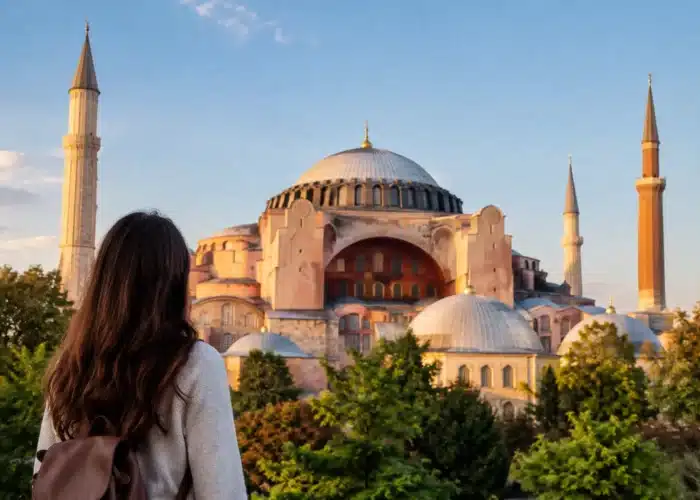
For travelers standing in Sultanahmet Square, the question is rarely whether Hagia Sophia is worth seeing. It is whether they will be allowed inside – and what they will actually be able to see once they enter. Can visitors enter Hagia Sophia? Yes, international visitors can enter designated visitor areas, but Hagia Sophia is an active mosque with access rules, prayer-time considerations, and a different visitor experience than many guests expect.
Since the introduction of a separate tourist route, planning matters more than ever. A well-timed visit protects your sightseeing time, respects the religious setting, and ensures this defining Istanbul landmark feels as meaningful as it should.
Can Visitors Enter Hagia Sophia Today?
Yes. Non-worshipping international visitors are generally admitted through the designated tourist entrance and follow a controlled route to the upper gallery level. From there, guests have a remarkable elevated view across the vast central space, its monumental dome, Ottoman calligraphic medallions, and layers of Byzantine and Islamic architectural history.
The key distinction is that the main prayer hall at ground level is reserved for worshippers. Visitors should not expect to walk freely through every section of the building as they might in a conventional museum. This arrangement reflects Hagia Sophia’s current role as a mosque while still allowing international guests to appreciate one of the world’s most consequential monuments.
Visitor policies, opening hours, ticket prices, and access routes can change, particularly around religious holidays, official events, restoration work, or security requirements. A private guide or professionally arranged Istanbul itinerary can confirm the practical details close to your travel date, rather than relying on outdated advice.
What You Will See From the Visitor Gallery
The gallery route is not a lesser substitute for seeing Hagia Sophia. It offers one of the building’s most memorable perspectives. Looking down from above reveals the scale and geometry of the interior in a way that is difficult to grasp from the floor.
You can observe the central dome, the marble pavements below, the mihrab indicating the direction of Mecca, and the immense roundels bearing the names of Allah, the Prophet Muhammad, and early Islamic leaders. The upper level also brings visitors closer to important Byzantine features, including surviving mosaics that speak to Hagia Sophia’s nearly 1,500-year history.
That said, the experience has a trade-off. Visitors looking for unrestricted ground-floor access, extended time beneath the dome, or a museum-style visit should adjust expectations. The visitor route is curated and more structured than it was in previous years. For many travelers, this makes expert interpretation even more valuable: Hagia Sophia’s story is layered, and its most revealing details are easy to miss without context.
A landmark with multiple identities
Completed in 537 during the reign of Emperor Justinian I, Hagia Sophia served as the principal cathedral of the Byzantine Empire for centuries. Following the Ottoman conquest of Constantinople in 1453, it became a mosque. It later operated as a museum before returning to mosque status in 2020.
These transitions are visible throughout the building. Christian mosaics, imperial symbolism, Islamic inscriptions, minarets, and Ottoman additions are not separate chapters locked away from one another. They coexist in the same space. Visitors who understand that complexity often find Hagia Sophia more moving than those who arrive expecting a single, simple narrative.
Prayer Times and the Best Time to Visit
Because Hagia Sophia is an active mosque, prayer times shape the visitor schedule. Tourist access may pause or be limited before, during, and shortly after daily prayers, with Friday midday prayers requiring particular care. The timing shifts throughout the year because prayer times follow the sun, so there is no single fixed schedule that applies to every date.
For the smoothest experience, aim for an early morning or later-afternoon visit outside prayer periods. This can also help you avoid the largest crowds, especially during Istanbul’s busy spring, summer, and cruise-season months. Friday is possible, but it is usually not the best choice for travelers with limited time in the historic peninsula.
Ramadan, Eid celebrations, and major Turkish public holidays can bring heavier worshipper attendance and modified visitor access. These periods offer a powerful sense of living religious tradition, but they demand more flexibility. Families, cruise guests, and travelers on a tightly planned itinerary may prefer to schedule Hagia Sophia on a standard weekday.
A qualified local guide can sequence Hagia Sophia with the Blue Mosque, Basilica Cistern, Topkapi Palace, and the Grand Bazaar around the day’s access conditions. This is especially useful in Sultanahmet, where several major sights sit within a short walk but operate on very different schedules.
Dress Expectations for Hagia Sophia
Dress respectfully, as you would for a place of worship. Clothing should cover shoulders and knees, and visitors should avoid very short shorts, sleeveless tops, or revealing outfits. Women are expected to cover their hair inside the mosque area. Carrying a lightweight scarf is an easy, polished solution and saves time at the entrance.
Choose shoes that are comfortable for uneven historic streets and stairs, particularly if you are visiting the upper gallery. The route is generally manageable, but it may not suit every traveler with mobility limitations. If accessibility is a concern, discuss it before committing to a timed itinerary so your day can be designed around comfort rather than rushed compromises.
A respectful visit also means keeping voices low, following staff instructions, avoiding flash photography where prohibited, and recognizing that worshippers have priority. Photography policies can be adjusted on site, so a guide’s direction and posted signage should always take precedence over assumptions.
Tickets, Entry, and Guided Visits
International visitors should expect an admission charge for the tourist route. Entry arrangements are separate from the worshipper entrance, and the ticketed visitor experience typically provides access to the gallery route rather than the central prayer floor. Fees and payment procedures are subject to change, so confirm the current arrangement shortly before your visit.
A ticket is not the same as unrestricted access. It does not override prayer-time pauses, security screening, crowd controls, or temporary closures. This is one reason independent travelers can lose more time here than anticipated, particularly when they arrive at the same moment as a large tour group or a prayer period begins.
For travelers who value context and efficiency, a private guided Istanbul experience is the strongest option. Your guide can arrive at the appropriate entrance, interpret what you are seeing, adapt the route when access changes, and build the rest of the day around the historic peninsula’s rhythms. Bosphorus Gate Travel designs private itineraries with this kind of on-the-ground precision, combining cultural depth with the reassurance of coordinated logistics.
Pairing Hagia Sophia with nearby highlights
Hagia Sophia works beautifully as the centerpiece of a half-day Sultanahmet visit. The Blue Mosque sits directly across the square, while the Basilica Cistern and Topkapi Palace are a short walk away. The right combination depends on your pace and interests.
Travelers focused on architecture may pair Hagia Sophia with the Blue Mosque and the Basilica Cistern. History-minded guests often add Topkapi Palace, allowing time for the Ottoman court’s collections and views over the Bosphorus. Cruise passengers with only a few hours should prioritize a carefully paced route rather than attempting every landmark, since lines, security, and walking time can reshape even the best plan.
Practical Planning Advice Before You Go
Arrive with flexibility and allow more time than the visit itself appears to require. The tourist entrance may be different from the route used by worshippers, and the approach can be busy. Keep a scarf accessible, bring only what you need for security screening, and plan a nearby alternative such as the Basilica Cistern if prayer access or crowd levels delay entry.
Most importantly, approach Hagia Sophia as a functioning sacred place rather than a checklist attraction. The building rewards patience. From its visitor gallery, you are looking across centuries of faith, empire, artistry, and change – a perspective that can become the defining moment of an expertly curated Istanbul journey.
[…] with a private guided visit to Hagia Sophia, a monument that has shaped the city’s religious and architectural story for nearly 1,500 […]
[…] Istanbul, the historic peninsula is the natural starting point. Hagia Sophia is central to any serious heritage itinerary because it embodies the city’s changing identity. […]