
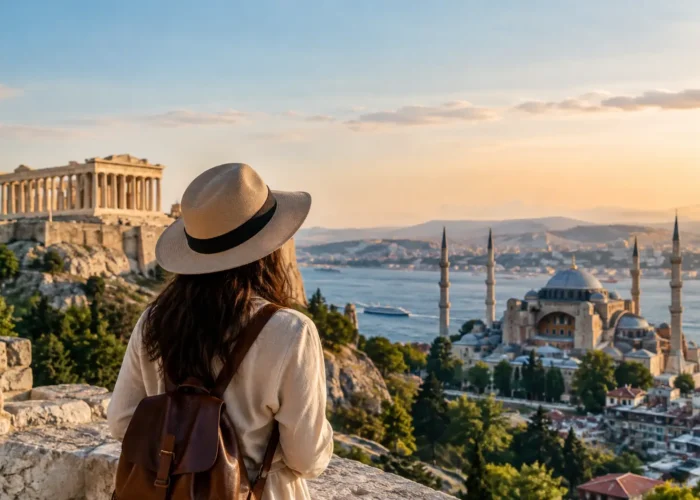
Athens and Istanbul are not simply two celebrated cities on one itinerary. They are two powerful chapters in the story of the Mediterranean, connected by empire, faith, trade, art, and ideas. This Athens Istanbul heritage guide is designed for travelers who want to experience those connections with context, comfort, and enough time to let each destination speak for itself.
For private travelers, the advantage is not seeing more monuments in less time. It is seeing the right places in the right order, with an expert guide who can turn a temple, church, palace, or waterfront into part of a larger story. A thoughtfully paced journey makes the contrast more memorable: Athens reveals the foundations of classical civic life, while Istanbul shows how successive empires transformed that inheritance into something global and distinctly its own.
Why Athens and Istanbul Belong on One Heritage Journey
Athens is often approached as the birthplace of democracy, philosophy, and classical art. Its greatest sites are concentrated around the Acropolis, where the Parthenon remains an extraordinary statement of civic ambition and architectural refinement. Yet the city is more layered than its ancient ruins alone. Roman Athens, Byzantine churches, Ottoman-era neighborhoods, and contemporary Greek life all remain part of the experience.
Istanbul offers a different kind of historical scale. Formerly Byzantium and Constantinople, it served as the capital of the Eastern Roman, Byzantine, and Ottoman empires. Here, heritage is not limited to an archaeological zone. It unfolds across grand squares, active mosques, former churches, imperial residences, markets, and the waterway that divides Europe and Asia.
Together, the cities make a compelling study in continuity. Athens provides the classical reference point. Istanbul demonstrates how Greek and Roman traditions were preserved, reinterpreted, and expanded by Byzantine and Ottoman rulers. Travelers interested in art history, religion, architecture, or Mediterranean culture will find that the pairing adds depth to both destinations.
Athens Istanbul Heritage Guide: Where to Begin
Begin in Athens, where the visual language of the ancient world is clearest. An early private visit to the Acropolis allows time to appreciate the Parthenon, Erechtheion, Propylaea, and Temple of Athena Nike before the site becomes busiest. The value of a guide is especially clear here. The Acropolis can appear familiar from photographs, but its political purpose, precise construction, and later transformations become much more meaningful when explained on site.
The Acropolis Museum is an essential complement rather than an optional add-on. Its galleries place original sculptures, architectural fragments, and everyday artifacts in a carefully designed sequence, culminating in views back toward the Acropolis itself. Plan sufficient time for both. Rushing from the hill to the museum misses the conversation between monument and collection.
Continue through the Ancient Agora, once the social and commercial heart of Athens. The remarkably preserved Temple of Hephaestus and the reconstructed Stoa of Attalos help visitors imagine how public life functioned beyond the ceremonial grandeur of the Acropolis. Nearby, the Roman Agora and Hadrian’s Library show how Athens continued to evolve under Roman patronage.
A well-curated Athens day should also include the Plaka and Anafiotika neighborhoods, where narrow lanes and small churches introduce a more intimate side of the city. For travelers with a special interest in Byzantine heritage, the Byzantine and Christian Museum adds valuable context before the journey continues east.
Istanbul’s Imperial Layers, Seen With Context
In Istanbul, the historic peninsula is the natural starting point. Hagia Sophia is central to any serious heritage itinerary because it embodies the city’s changing identity. Built in the sixth century as a Byzantine cathedral, converted into an Ottoman mosque after 1453, and used in different capacities in the modern era, it rewards careful interpretation. Its immense dome, mosaics, calligraphic roundels, and architectural innovations reveal centuries of cultural negotiation in one setting.
Across Sultanahmet Square, the Blue Mosque presents Ottoman imperial architecture at its most graceful. The relationship between these two landmarks matters: the mosque was conceived in dialogue with Hagia Sophia, not apart from it. Nearby, the Hippodrome recalls Constantinople’s former civic arena, while the Basilica Cistern introduces the practical engineering beneath the imperial capital.
Topkapi Palace adds another essential perspective. This was not merely a royal residence but the administrative and ceremonial center of the Ottoman Empire for centuries. Its courtyards unfold gradually, moving from public authority toward increasingly private imperial spaces. A private guide can help distinguish between legend and documented history while making the palace’s political role easier to understand.
The Grand Bazaar and Spice Market deserve a place in the itinerary, particularly when approached as historic trading institutions rather than quick shopping stops. Their energy can be exhilarating, but timing matters. A guided visit earlier in the day allows for a more relaxed introduction to the traditions of craftsmanship, textiles, ceramics, spices, and hospitality that shaped Ottoman commercial life.
Create a Journey That Is Rich, Not Rushed
A common mistake is treating Athens as a two-night prelude to Istanbul. For most heritage-focused travelers, three nights in Athens and four nights in Istanbul is a more comfortable minimum. This allows for a proper first day in each city, space for museum visits, and flexibility for weather, museum closures, or a slower lunch in a historic neighborhood.
The ideal balance depends on your interests. Travelers drawn to antiquity may want an additional Athens day for Cape Sounion, the National Archaeological Museum, or a private excursion to Delphi. Those captivated by Byzantine and Ottoman history may prefer extra time in Istanbul for the Chora Church, the Archaeological Museums, the Galata district, and a Bosphorus cruise that reveals the city’s waterfront palaces, fortifications, and villages.
Avoid planning major museums, palace interiors, and extensive walking tours on the same day as international flights. Both cities reward alertness. The uneven stones of the Acropolis and the crowds around Sultanahmet can be demanding, particularly in summer. Private transportation, well-timed entries, and a guide who can adapt the sequence of the day make a noticeable difference.
Heritage Experiences Beyond the Headline Sites
The most memorable moments often happen beyond the landmarks everyone recognizes. In Athens, that may mean tasting seasonal Greek dishes in a family-run taverna after an afternoon of archaeology, or visiting a workshop where traditional crafts continue in a modern city. In Istanbul, it may mean crossing by ferry at sunset, hearing the call to prayer carry across the Bosphorus, or exploring the less-visited streets around Fener and Balat, where Greek Orthodox, Armenian, Jewish, and Ottoman histories intersect.
Cuisine is also part of the heritage conversation. Greek and Turkish tables share ingredients and techniques shaped by the Aegean, Anatolia, migration, and trade. Olive oil, herbs, grilled seafood, stuffed vegetables, yogurt, pastries, and coffee traditions offer delicious points of connection, even as each city gives them a distinctive character. A private culinary experience can bring this shared regional history into focus without turning the trip into a rigid food tour.
For families, heritage planning should include shorter site visits, engaging stories, and breaks built around views or local treats. For couples and honeymooners, the focus may shift toward private sunset sailing, boutique accommodations, and unhurried dinners. There is no single correct version of this journey, which is precisely why a tailored itinerary is so valuable.
Practical Planning for a Private Athens and Istanbul Itinerary
The best seasons are generally April through early June and September through October, when temperatures are more comfortable and walking is easier. July and August offer long daylight hours but bring higher heat and larger crowds, especially in Athens. Winter can be an excellent choice for museum-focused travelers who prefer fewer visitors, though outdoor plans should allow for rain and shorter days.
Travel between Athens and Istanbul is typically most efficient by air. Schedule the transfer as a light travel day rather than trying to add a major sightseeing program at either end. Keep passports readily accessible and allow time for airport procedures, particularly when crossing from Greece into Turkey.
For an elevated experience, reserve private guiding for the heritage-rich core days and use private vehicles where they save meaningful time or energy. Not every moment needs to be programmed. A thoughtful itinerary should leave room for a café terrace in Athens, an unplanned gallery in Istanbul, or a quiet pause at a viewpoint above the Bosphorus.
Bosphorus Gate Travel can curate a private Athens and Turkey journey around your preferred pace, historical interests, hotel style, and comfort requirements. Expert local guidance, carefully managed transportation, and personalized timing allow the experience to feel considered rather than over-scheduled.
The most rewarding way to travel between Athens and Istanbul is to treat each city as more than a collection of famous sites. Give yourself time to look closely, ask questions, and notice the threads that connect a marble temple in Athens to a domed monument beside the Bosphorus.