
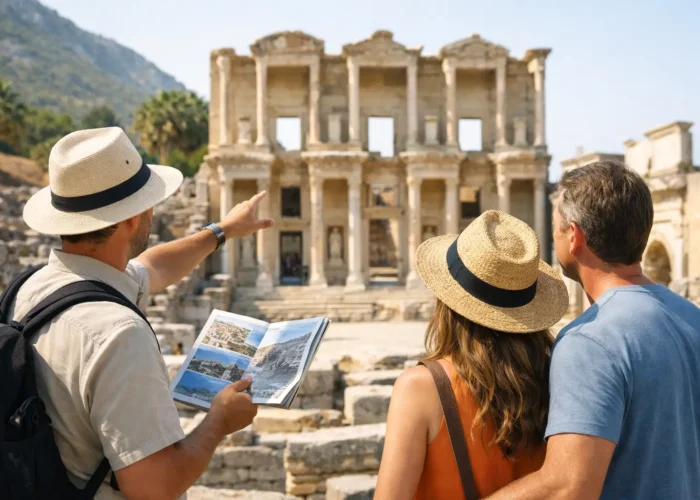
The marble avenue is bright, the ruins are vast, and the stories at Ephesus are layered across centuries. An Ephesus history tour guide turns this remarkable archaeological site from a collection of columns and façades into a living Roman port city – one shaped by trade, political power, faith, and daily life.
For travelers arriving from Kusadasi, Izmir, or a cruise ship, Ephesus can appear straightforward on a map. In practice, its scale, heat, crowds, and historical complexity reward thoughtful planning. A private, expertly curated visit creates the space to understand what you are seeing, move at your preferred pace, and focus on the parts of the ancient city that matter most to you.
What an Ephesus History Tour Guide Adds to Your Visit
Ephesus was one of the great cities of the Roman world, not a small provincial settlement. At its height, it was a commercial and cultural center on the Aegean coast, with a population often estimated in the hundreds of thousands. Its harbor has since silted up, leaving the site inland today, but the city was once connected directly to Mediterranean trade routes.
A knowledgeable guide gives this change meaning. Standing on Harbor Street, you can picture ships, merchants, travelers, and imperial officials entering a prosperous city. At the Grand Theater, which could hold roughly 25,000 people, the discussion can move beyond impressive dimensions to public life, performances, political assemblies, and the early Christian history associated with the Apostle Paul.
That context matters because Ephesus is not defined by one era. It carries traces of Greek settlement, Hellenistic planning, Roman prosperity, Byzantine Christianity, and centuries of archaeological work. The best tours make these transitions clear without overwhelming guests with dates. They explain what is known, what has been reconstructed, and where historians still debate the finer details.
The Essential Stops and Why They Matter
A well-paced private Ephesus visit usually follows the city downhill, beginning near the Upper Gate and ending by the Grand Theater. This route is practical, but it also creates a strong historical progression through civic, commercial, and residential spaces.
The Odeon, State Agora, and Curetes Street
Near the upper entrance, the Odeon introduces the administrative side of Ephesus. This smaller theater was used for council meetings and performances, while the nearby State Agora served as an important public and political space. These structures establish Ephesus as a disciplined Roman city with institutions, ceremonies, and a clear civic identity.
From there, Curetes Street leads through some of the site’s most recognizable scenery. Its marble paving, colonnades, fountains, monuments, and remains of shops reveal how carefully the city presented itself. Your guide can point out details that are easy to miss, including honorary inscriptions, decorative reliefs, and the evidence of ancient urban infrastructure beneath your feet.
The Terrace Houses
For many travelers, the Terrace Houses are the most revealing part of Ephesus. Set into the slope beside Curetes Street, these homes belonged to affluent residents and preserve mosaics, frescoes, heating systems, courtyards, and sophisticated water features.
The Terrace Houses require a separate admission and involve walking on elevated platforms. They are not necessary for every guest, especially if time is limited or mobility is a concern. Yet for visitors interested in domestic life, art, and the contrast between public grandeur and private comfort, they are exceptionally worthwhile. This is where ancient Ephesus feels most personal.
The Library of Celsus and Commercial Agora
The Library of Celsus is Ephesus’s iconic landmark, and its reconstructed façade is among the most photographed sights in Turkey. Built in the second century AD as a memorial to Tiberius Julius Celsus Polemaeanus, it once housed thousands of scrolls and served as both a library and a monumental tomb.
A guide adds necessary perspective here. The building’s façade has been carefully reassembled from original fragments, while much of the interior is no longer standing. Rather than diminishing the experience, this distinction helps visitors appreciate both Roman architecture and the meticulous work of modern archaeology.
Just below the library, the Commercial Agora recalls the city’s role in regional trade. Ephesus was a place where goods, ideas, languages, and religious traditions met. The setting makes more sense when viewed as a bustling marketplace rather than an empty expanse of stone.
The Grand Theater
The Grand Theater is the natural finale for many Ephesus tours. Its enormous seating area faces the old harbor road, creating a powerful sense of the city’s former scale. It was a venue for entertainment, but it also played a role in civic life and, according to Christian tradition, in the conflict described in the Acts of the Apostles.
Visitors often want time here for photographs, a quiet look across the site, or simply a moment to absorb the setting. Private touring is particularly valuable at this point because there is no need to rush onward with a large group.
Beyond the Main Archaeological Site
The broader Ephesus region deserves attention, especially for guests who want a deeper historical and spiritual experience. The House of the Virgin Mary, located in the hills above the ancient city, is revered by many Christian and Muslim visitors. It is a place of devotion rather than an archaeological ruin, so the tone of a visit should be respectful and unhurried.
The Basilica of St. John in nearby Selcuk is another meaningful stop. Built under Emperor Justinian in the sixth century, it stands over the traditional burial site of St. John the Apostle and offers expansive views toward the ancient landscape.
The Temple of Artemis is equally significant historically, although travelers should set expectations correctly. Once one of the Seven Wonders of the Ancient World, very little remains visible today. An expert guide can explain its former importance and help visitors understand why its modest present-day appearance should not be mistaken for a minor historical role.
Why Private Pacing Changes the Experience
Ephesus is best experienced early in the day, when temperatures are milder and the archaeological site is less crowded. For cruise guests, timing is even more important. Ship schedules, port traffic, admission lines, and the return drive to Kusadasi all need to be managed with precision.
A private tour provides the flexibility to prioritize what fits your interests. Couples may prefer extended time in the Terrace Houses and a relaxed regional lunch. Families may benefit from a shorter route with clear storytelling and rest stops. Travelers with limited mobility can focus on the most accessible sections of the site, recognizing that ancient marble streets are uneven and some areas have steps.
This is also where luxury transportation and advance arrangements make a meaningful difference. Comfortable transfers, coordinated entry, and a guide who adjusts the route in real time allow the day to feel considered rather than tightly managed. The goal is not to see every stone. It is to leave with a genuine sense of the city and the people who once lived there.
Planning an Ephesus Visit with Confidence
Comfortable walking shoes, sun protection, water, and light layers are essential. The site is largely exposed, and its polished marble can be slippery in places. Guests should also plan for a substantial amount of walking, though a private itinerary can be adapted to individual comfort levels.
When selecting an Ephesus experience, ask whether the guide is licensed, whether transportation is private, how admission arrangements are handled, and whether the itinerary can include the Terrace Houses, St. John’s Basilica, or the House of the Virgin Mary. These details separate a standard stop from a well-managed cultural day.
Bosphorus Gate Travel designs private Ephesus experiences around the traveler, combining expert local guidance, comfortable transportation, and carefully timed access for a more rewarding visit. Whether Ephesus is one day within a larger Turkey journey or the centerpiece of a shore excursion, the right planning lets its history feel immediate rather than distant.
As you stand beneath the Library of Celsus or look down Harbor Street toward the former sea, allow time for more than a photograph. The lasting value of Ephesus is found in recognizing how vividly one ancient city still speaks through its streets, homes, temples, and public spaces.