
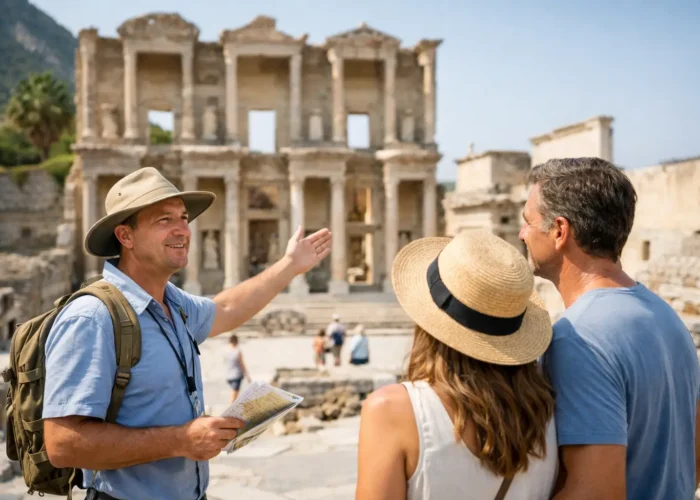
Ephesus is not a site where the most memorable details announce themselves. The marble avenue may look like a beautiful route through ancient ruins, but without context, it is easy to miss the political theater, daily rituals, engineering, and personal stories that made this Roman city extraordinary. So, do you need a guide in Ephesus? Not always. But for many travelers, especially first-time visitors and cruise guests with limited time, a knowledgeable private guide changes the visit from a walk among ruins into a clear, compelling journey through one of the ancient world’s great cities.
Do You Need a Guide in Ephesus?
You can certainly visit Ephesus independently. The archaeological site is well marked, and travelers who enjoy moving at their own pace can follow the main route from the upper gate toward the Library of Celsus, the Great Theater, and the lower exit. A self-guided visit can work well if you have ample time, have researched the site in advance, and are comfortable arranging transportation and tickets.
The trade-off is depth and efficiency. Ephesus is large, often hot, and layered with more than a thousand years of Greek, Roman, early Christian, and Byzantine history. Plaques provide a basic introduction, but they cannot always explain why the Curetes Street was built on a slope, how a public latrine functioned, or why the library’s imposing facade became an enduring symbol of the city. An expert guide brings those connections to life while setting a pace that suits your interests and energy level.
For travelers who value cultural context, private transportation, and a well-organized day, guided touring is usually the stronger choice. It is particularly valuable when Ephesus is one part of a wider Kusadasi shore excursion or an itinerary that includes the House of the Virgin Mary, the Temple of Artemis, or the charming hillside village of Sirince.
What a Private Ephesus Guide Adds
A guide does more than recite dates. The best experience begins with a thoughtful route and a conversation about what you want from the day. A family may want lively stories of gladiators, Roman baths, and ancient schools. A couple may prefer unhurried time for photography and the elegant architecture of the library. Travelers interested in Christian heritage may want a deeper explanation of St. Paul’s ministry, the Basilica of St. John, and the House of the Virgin Mary.
At Ephesus, context is the difference between seeing stones and recognizing a functioning city. Your guide can explain how the Harbor Street once linked the port to the commercial center, why the Great Theater could hold roughly 25,000 spectators, and how wealthy residents decorated their homes with intricate mosaics and frescoes. These details make the scale of Ephesus easier to grasp.
Private guiding also helps with practical decisions that are easy to underestimate. Your guide can recommend the most comfortable entrance based on your route, manage timing around crowds, point out shade and rest opportunities, and help you avoid spending valuable time figuring out the site’s layout. During high season, this local knowledge can make the day feel far more relaxed.
The Terrace Houses Are a Strong Reason to Have Context
The Terrace Houses, also called the Houses of the Rich, are among Ephesus’s most rewarding areas. Set into the slope opposite the Temple of Hadrian, these excavated residences reveal how affluent families lived, entertained, and displayed their status. Their preserved mosaics, painted walls, heating systems, and interior courtyards offer a more intimate view of Roman life than the monumental buildings outside.
They are also an additional-ticket area and involve stairs. A private guide can help you decide whether the visit fits your interests, mobility, and available time. If you do enter, interpretation matters. What may first appear to be a fragment of flooring or a painted wall becomes evidence of taste, wealth, domestic life, and sophisticated urban infrastructure.
When an Independent Visit Makes Sense
A guide is not essential for every traveler. If you are an experienced independent traveler, enjoy archaeology, and have a full day in the region, you may prefer the freedom of exploring at your own rhythm. An audio guide or carefully chosen guidebook can provide useful background, and visiting early in the morning can make the experience more comfortable.
Independent travel may also be appealing if Ephesus is a return visit. Perhaps you have already seen the major monuments and simply want time to photograph the Library of Celsus, linger in the theater, or revisit a favorite corner of the site. In that case, your familiarity lets you focus on the details that interest you most.
Still, self-guiding requires more planning. You will need to arrange transportation from Kusadasi, Selcuk, Izmir, or your cruise port; confirm entrance procedures; understand what is included with each ticket; and account for the fact that the main archaeological route is largely downhill. Taxis and local options are available, but coordinating them can feel less straightforward than it appears, especially when ship schedules or flight connections are involved.
Why Cruise Travelers Often Benefit Most
For cruise passengers arriving in Kusadasi, time is the decisive factor. Ephesus is close enough for a rewarding port-day visit, but a missed ship is not an acceptable risk. A professionally managed private shore excursion provides the confidence of a planned route, timely transportation, and a guide who understands how to balance historical immersion with your all-aboard time.
Rather than rushing through the site with a large group, a private experience allows you to focus on the places that matter most to you. You might combine Ephesus with the House of the Virgin Mary for a faith-focused day, add the Terrace Houses for a richer archaeological experience, or enjoy a relaxed lunch in Selcuk before returning to the port. The itinerary should be built around your ship’s schedule, not a generic sightseeing template.
This is where Bosphorus Gate Travel’s curated private touring approach is especially valuable: the details of transportation, pacing, admissions, and return timing are managed with care, allowing you to focus on the destination rather than logistics.
Choosing the Right Type of Guide
Not all guided experiences deliver the same value. A large coach tour can be efficient and budget-friendly, but it often follows a fixed schedule and moves at the pace of the group. You may spend less time at the sites that interest you most, and more time waiting at meeting points or shopping stops that were not part of your priorities.
A private licensed guide offers greater flexibility. You can ask questions as they arise, adjust the pace in warm weather, and shape the day around archaeology, religion, cuisine, photography, or family-friendly storytelling. For travelers seeking a premium experience, pairing a guide with a private vehicle and experienced driver creates a more comfortable transition between Ephesus and nearby landmarks.
When comparing options, ask whether the guide is licensed, whether transportation is private, how entrance arrangements are handled, and whether the itinerary can be customized. Also clarify how much walking is involved. Ephesus is accessible for many visitors, but uneven ancient surfaces, sun exposure, and the downhill route deserve honest consideration.
How to Make Your Guided Visit More Rewarding
Even with expert planning, a few choices will improve your day. Start early when possible, particularly from late spring through early fall, when midday heat can be intense. Wear supportive walking shoes, bring water and sun protection, and carry a light layer if visiting during cooler months.
Share your priorities before the tour begins. Tell your guide if you are especially interested in the early Christian world, Roman engineering, ancient art, or the everyday lives of Ephesus’s residents. Mention mobility needs, photography interests, and whether you want a relaxed lunch or a more comprehensive day of touring. The more clearly your preferences are understood, the more personal the experience becomes.
It is also wise to leave room for discovery. Ephesus has iconic landmarks, but some of its most meaningful moments come in quieter places: a carved inscription, a water channel beneath the street, a shaded colonnade, or a view across the former harbor plain that explains why this city once mattered so much.
A guide is not a requirement for entering Ephesus. It is an investment in understanding it. If this is a once-in-a-lifetime visit, choose the level of support that lets you look up from the map, ask better questions, and give this remarkable ancient city the attention it deserves.