
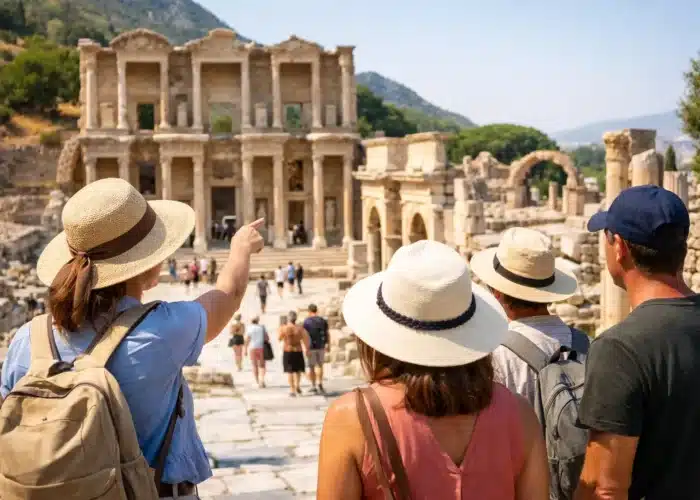
The marble avenue from the Upper Gate to the Library of Celsus is not simply a collection of impressive ruins. It is the former civic heart of one of the Roman Empire’s greatest port cities, shaped by emperors, merchants, philosophers, and early Christians. A guided tour of ancient Ephesus gives those stones their proper context, turning a memorable walk into a meaningful encounter with antiquity.
For travelers visiting from Kusadasi, Izmir, or a cruise ship, Ephesus rewards thoughtful planning. The site is large, the sun can be intense, and its most important stories are not always obvious from a signboard. A private guide helps you move through the ancient city at a comfortable pace while focusing on the archaeology, architecture, and biblical or classical history that matters most to you.
Why Ephesus Is Best Seen With an Expert Guide
Ephesus was once a prosperous harbor city on the Aegean coast and a major center of trade, religion, and Roman administration. Today, the sea sits several miles away because centuries of sediment changed the shoreline. That fact alone explains much of the city’s rise and decline, yet it is easy to miss without someone connecting the landscape to the ruins before you.
An expert guide also helps distinguish what you are seeing from what you may imagine. The grand façade of the Library of Celsus is partly reconstructed, while the street beneath your feet preserves original marble paving and ancient drainage systems. The Great Theater was built for civic performance and later became associated with St. Paul’s ministry. These details make the visit more precise and far more engaging.
Private touring offers another advantage: flexibility. Classical-history enthusiasts may want added time at the Terrace Houses, where frescoes, mosaics, and sophisticated domestic spaces reveal how Ephesus’s elite lived. Travelers with a biblical focus may prefer to discuss the Apostle Paul, the Book of Ephesians, and the city’s early Christian community. Families may favor a shorter route with frequent pauses and clear storytelling. There is no single correct way to experience Ephesus.
What You Will See on a Guided Tour of Ancient Ephesus
Most well-planned visits begin at the Upper Gate and follow a gentle downhill route through the archaeological site. Starting high and walking down is generally more comfortable than reversing the route, especially in warmer months. It also creates a striking progression from administrative spaces to the city’s monumental public center.
The State Agora and Odeon
Near the entrance, the State Agora introduces Ephesus as a political city, not merely a tourist landmark. This open square was used for official gatherings, while the nearby Odeon served as a small theater and council chamber. Its tiered seating offers an early sense of the city’s scale and civic ambition.
Curetes Street and the Temple of Hadrian
As you descend Curetes Street, columns, monuments, and fragments of statuary trace the route once taken by residents and visitors. The elegant Temple of Hadrian is among the street’s most photographed structures. Its ornamental arch and reliefs are beautiful, but the more interesting story lies in what they communicate: public architecture was also a language of power, loyalty, and identity in Roman Ephesus.
Your guide can point out the practical details that bring the street to life, from water channels to the remains of fountains and shops. These are the features that help visitors picture a functioning city rather than an abandoned one.
The Terrace Houses
The Terrace Houses are an optional but highly recommended addition for travelers seeking a deeper view of daily life. Built into the slope above Curetes Street, these residences belonged to wealthy Ephesian families. Their painted walls, decorative mosaics, private bathing areas, and heating systems show a level of comfort that feels surprisingly familiar.
This section requires a separate admission ticket and involves stairs, so it is not ideal for every mobility level or every short shore-excursion schedule. For those with the time and interest, however, it is often the most revealing part of the site. Monumental ruins tell the story of public Ephesus; the Terrace Houses tell the story of the people who lived there.
The Library of Celsus
The Library of Celsus is Ephesus’s defining image. Built in the second century AD to honor the Roman senator Tiberius Julius Celsus Polemaeanus, it was both a library and a monumental tomb. The façade is framed by statues representing virtues such as wisdom and knowledge, a fitting statement for a building that once held thousands of scrolls.
Arriving here with the right historical background changes the experience. The building is not a quiet, isolated library in the modern sense. It stood on a busy urban street, close to commercial spaces, public monuments, and the agora. It was designed to be seen and admired.
The Great Theater
The lower end of the site opens onto the Great Theater, which could hold an estimated 24,000 spectators. Its size remains remarkable, even after nearly two millennia. Performances, assemblies, and public debates took place here, and its connection to the Acts of the Apostles makes it especially significant for many visitors.
A guide can explain how acoustics, seating hierarchy, and spectacle shaped Roman public life. If restoration work or access restrictions affect the theater on the day of your visit, an experienced local team can adjust the route and ensure the broader story of Ephesus is still fully represented.
Planning the Right Ephesus Experience
Ephesus is located near Selcuk, roughly 20 minutes from Kusadasi and about an hour from Izmir. Cruise travelers should allow generous time for the return journey to port, particularly during the busy season. Private transportation removes much of the uncertainty, with a driver ready at the agreed meeting point and an itinerary paced around your ship’s schedule.
Morning is usually the most comfortable time to visit, particularly from late spring through early fall. The site has limited shade, and the bright marble reflects heat. Comfortable walking shoes, sun protection, water, and a light layer for cooler spring or fall mornings are sensible essentials. The primary route is downhill, but it includes uneven surfaces and occasional steps.
Skip-the-line arrangements can be valuable when visitor numbers are high, though they do not eliminate the time needed for security checks or entry procedures. They are especially useful for guests arriving on a fixed cruise schedule or travelers who want to devote more of the day to the ruins, the Terrace Houses, or nearby sites.
Extending Your Day Beyond the Ruins
Ephesus becomes even more rewarding when viewed within its wider setting. The House of the Virgin Mary, located in the hills above the ancient city, is a place of pilgrimage for many Christian travelers. Its importance is spiritual rather than archaeological, and it offers a quieter contrast to the scale of Ephesus.
The Basilica of St. John in Selcuk is another meaningful stop. It stands over the traditional burial site of St. John and looks toward Ayasuluk Hill, where the remains of a Byzantine fortress add another layer to the region’s long history. Nearby, the Ephesus Archaeological Museum holds statues and artifacts found at the site, including objects that provide detail and color not always visible among the outdoor ruins.
The Temple of Artemis deserves a realistic expectation. One of the Seven Wonders of the Ancient World once stood here, but little remains above ground. For some travelers, the stop is essential because of its historical importance. For others, limited time may be better spent at the Terrace Houses or museum. A tailored itinerary makes room for the places that will matter most to you.
Bosphorus Gate Travel can arrange a private Ephesus experience with an expert licensed guide, premium transportation, priority entry planning, and a schedule designed around your interests and timing. Whether your day centers on Roman history, early Christianity, archaeology, or a refined shore excursion, the difference lies in having every detail considered before you arrive.
Ephesus is at its best when there is room to pause: at a mosaic beneath the Terrace Houses, beneath the Library of Celsus, or in the theater where a crowd once changed the course of a story. Choose an itinerary that gives this extraordinary city the time and attention it deserves.