
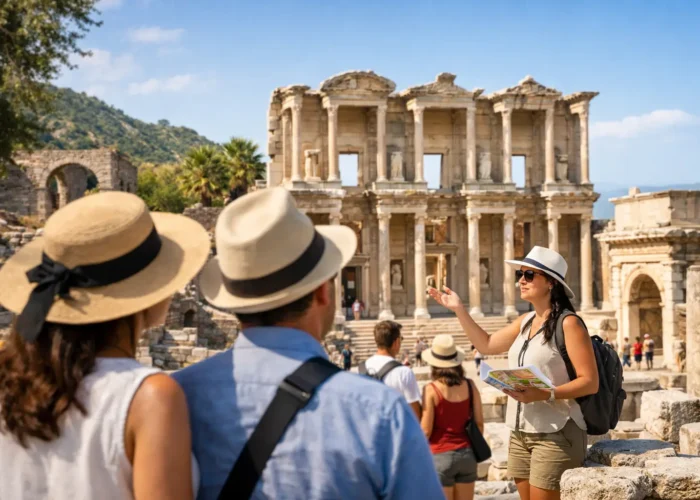
A first glimpse of Ephesus can feel almost cinematic: marble streets opening toward a grand theater, columns rising from a former Roman capital, and the Library of Celsus standing with remarkable poise against the Aegean light. The top Ephesus sites to visit deserve more than a quick checklist. With the right route, an expert guide, and enough time for the details, this extraordinary archaeological city becomes a vivid encounter with the ancient world.
For travelers arriving from Kusadasi, Izmir, or a cruise ship, Ephesus can be experienced in a half day. Yet a more rewarding private itinerary allows time for the major monuments, the intimate homes of the city’s elite, and the sacred sites nearby. The difference is not simply how much you see. It is having the context to understand how Roman commerce, early Christianity, imperial politics, and daily life intersected here.
Top Ephesus Sites to Visit Inside the Ancient City
1. The Great Theater
Begin with the Great Theater, the largest and most dramatic structure in Ephesus. Built into the slope of Mount Pion, it once held an estimated 24,000 spectators for performances, civic gatherings, and public debate. Its scale is striking even for travelers accustomed to Roman ruins.
The theater also carries particular significance for Christian visitors. According to the Acts of the Apostles, this was the setting for the uproar connected with St. Paul’s preaching in Ephesus. A guide can help distinguish between the monument’s Roman grandeur and the later religious history that makes it meaningful to so many visitors.
Morning is especially pleasant here, before the central route becomes busy and the stone seating absorbs the midday heat. From the upper levels, the former harbor road offers a clear sense of Ephesus as a powerful Mediterranean port city.
2. Harbor Street and the Commercial Agora
From the theater, look down Harbor Street, also known as the Arcadian Way. In antiquity, this broad, colonnaded avenue linked the harbor to the city center and provided an impressive arrival for merchants, dignitaries, and pilgrims. Today, the sea has receded several miles because of centuries of sedimentation, but the avenue still conveys the ambition of ancient Ephesus.
Nearby, the Commercial Agora reveals the city’s economic life. This was a place of trade, negotiation, imported goods, and public activity rather than a quiet residential square. It is easy to pass through quickly, but its location between the harbor and the civic center explains why Ephesus flourished as one of Roman Asia Minor’s most important cities.
3. The Library of Celsus
The Library of Celsus is Ephesus at its most recognizable. Its restored facade, with two stories of columns, niches, and sculpted figures, is one of the finest examples of Roman public architecture in Turkey. Built in the second century AD in honor of the Roman senator Tiberius Julius Celsus Polemaeanus, it held thousands of scrolls and served as a monumental tomb for its patron.
The library is often the most photographed stop, but it rewards close attention. The female statues represent wisdom, knowledge, intelligence, and virtue, ideals deliberately placed on a building that celebrated learning and civic status. Arriving earlier in the day gives travelers a better opportunity to appreciate the facade without the largest crowds.
4. Curetes Street
Curetes Street is the marble procession route that connects the lower city with Ephesus’s upper monuments. As you walk uphill, look for the worn grooves, inscriptions, fountains, and column fragments that reveal how densely built this city once was. The street itself is not just a path between landmarks. It is the framework that makes Ephesus feel like a functioning urban center rather than a collection of isolated ruins.
This portion of the visit is where a private guide adds particular value. Many of Ephesus’s most compelling details are easy to miss: a carved symbol, a reused stone, a public fountain, or an inscription that records a donor’s civic pride. The pace should be unhurried, particularly in warmer months, when the upward walk and sun exposure can be demanding.
5. The Terrace Houses
For many discerning travelers, the Terrace Houses are the most memorable stop in Ephesus. Located on the slope opposite Curetes Street, these remarkably preserved residences belonged to wealthy Ephesian families. Their frescoes, mosaics, marble floors, heating systems, and reception rooms offer a rare view of private life in the Roman world.
This site requires a separate admission ticket, and it is well worth including when time permits. Unlike the vast public spaces outside, the Terrace Houses show the sophistication and comforts of an elite home. Covered walkways also provide welcome shade, although there are stairs and elevated viewing platforms, so guests with limited mobility should discuss access needs in advance.
6. The Temple of Hadrian and Scholastica Baths
The Temple of Hadrian is a refined small monument along Curetes Street, known for its graceful arch and decorative reliefs. While it does not have the scale of the Great Theater or Library of Celsus, it represents the layers of honor, religion, and political identity that shaped Roman cities. Its details are best appreciated with interpretation, since some visible elements are reconstructions based on archaeological evidence.
Just beyond it, the Baths of Scholastica demonstrate that bathing was both a practical and social ritual. The surviving remains hint at the changing rooms, heated spaces, and gathering places that would have formed part of daily urban life. Together, these monuments make a useful pause between Ephesus’s headline sites and its deeper stories.
7. The Odeon, Prytaneion, and State Agora
At the upper end of the archaeological site, the Odeon offers a different kind of Roman spectacle. Smaller and more intimate than the Great Theater, it hosted concerts, council meetings, and covered performances. Its setting beside the State Agora places it at the heart of Ephesus’s political and ceremonial life.
The nearby Prytaneion was where sacred fire was maintained and distinguished guests were received. It is also associated with the famous statues of Artemis now displayed in the Ephesus Museum. These upper-city monuments can feel quieter than the Library of Celsus area, making them especially rewarding for travelers who value historical context over photographs alone.
Essential Ephesus Sites Beyond the Main Gate
8. The Basilica of St. John
A short drive from the ancient city, the Basilica of St. John stands on Ayasuluk Hill in Selcuk. Built by Emperor Justinian in the sixth century, it was constructed over the traditional burial place of St. John the Evangelist. The basilica’s ruins are expansive, and its elevated position provides fine views toward the surrounding countryside.
This is an essential addition for guests interested in early Christianity, Byzantine history, or the transition from Roman Ephesus to medieval Selcuk. It also adds a quieter, more contemplative dimension to a day that may otherwise be centered on monumental Roman architecture.
9. The Temple of Artemis
The Temple of Artemis was once one of the Seven Wonders of the Ancient World. Visitors should set expectations appropriately: very little of the original temple survives, and the site today is far less visually dramatic than Ephesus itself. Even so, it is an important stop because Artemis was central to the city’s identity, prosperity, and religious influence.
A brief visit works best when paired with the Basilica of St. John. From this area, an expert guide can explain how the ancient sanctuary once dominated the landscape and why its cult shaped Ephesus long before Christianity became established.
Should You Add the House of the Virgin Mary?
The House of the Virgin Mary lies in the hills above Ephesus and is one of the region’s most revered pilgrimage sites. Tradition holds that Mary spent her final years here under the care of St. John. The modest stone house, peaceful gardens, and nearby prayer wall create a very different atmosphere from the archaeological site.
Whether to include it depends on your priorities. Faith-focused travelers and those seeking a spiritual experience often consider it indispensable. Guests with limited time, especially cruise passengers, may prefer to concentrate on Ephesus, the Terrace Houses, and the Basilica of St. John. A carefully planned private itinerary can accommodate both, provided the day begins early and transportation is coordinated efficiently.
How to Experience Ephesus Well
Ephesus is best visited early, particularly between late spring and early fall. There is limited shade across the main archaeological route, and the polished marble can be uneven underfoot. Comfortable walking shoes, sun protection, water, and a light layer for religious sites are sensible choices.
For cruise guests, timing matters as much as site selection. The most satisfying shore excursion is built around the ship’s all-aboard time, current traffic conditions, and the desired balance of archaeology, religious heritage, and lunch in Selcuk or nearby Sirince. Private transportation and a licensed guide allow the order of stops to be adjusted around crowds and personal interests rather than a fixed coach schedule.
The most memorable visit is not measured by how quickly you reach the Library of Celsus. It comes from standing in the Great Theater, walking the same marble streets as Roman merchants, and leaving space for the details that turn a famous ruin into a deeply personal journey.