
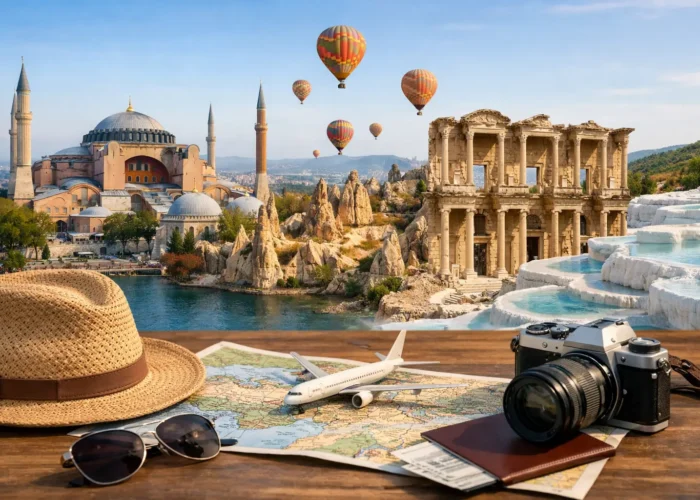
If you are planning your first trip to Turkey, the best Turkey itinerary for first timers is not the one that tries to do everything. It is the one that gives you a strong sense of the country’s culture, history, landscapes, and cuisine without turning every day into a connection, a hotel change, or a rushed checklist. For most travelers, that means focusing on four core destinations: Istanbul, Cappadocia, Ephesus, and Pamukkale.
This route works because it balances iconic highlights with variety. You get imperial history and world-class landmarks in Istanbul, surreal scenery in Cappadocia, classical antiquity in Ephesus, and the white travertine terraces of Pamukkale. Just as importantly, the logistics are manageable, especially when flights, transfers, and touring are arranged in a thoughtful sequence.
Why this is the best Turkey itinerary for first timers
Turkey is larger and more layered than many first-time visitors expect. On a map, adding the Mediterranean coast, Antalya, Bodrum, or the Black Sea can look tempting. In practice, trying to fit too many regions into one trip often means spending more time in transit than in the places you came to see.
A first journey should feel complete, not crowded. Istanbul deserves at least three nights because it is not a city you absorb in a single day. Cappadocia is best with two or three nights so you have time for both the valleys and the cave heritage, and so weather does not ruin your chance of a balloon experience. Ephesus and Pamukkale pair well in western Turkey, where Roman sites, thermal landscapes, and Aegean ease create a very different rhythm from Istanbul.
For most premium travelers, the sweet spot is 8 to 10 days. Shorter than that, and the trip starts to feel compressed. Longer than that, and you can expand comfortably with the coast, a gulet experience, or an Athens extension.
The ideal 8 to 10 day route
Days 1 to 3: Istanbul
Start in Istanbul, where nearly every first-time visit to Turkey should begin. The city gives you the essential introduction: Byzantine and Ottoman history, grand mosques, palaces, bustling bazaars, and one of the world’s great food scenes.
On your first full day, focus on the historic peninsula. Hagia Sophia, the Blue Mosque, the Hippodrome, and Topkapi Palace are best experienced with expert guidance because context changes everything here. These are not simply monuments. They tell the story of empires, religions, and centuries of political power. Skip-the-line access also matters in Istanbul, particularly in high season, when queues can easily consume a meaningful part of the day.
Your second day should shift from monuments to atmosphere. A Bosphorus cruise, the Spice Bazaar, and neighborhoods such as Balat, Karakoy, or Galata reveal the city’s texture beyond postcard landmarks. This is also the right moment to make room for a proper culinary experience, whether that means a refined meze dinner, a private food-focused walk, or simply slowing down long enough to enjoy Turkish breakfast and tea with a view.
If you have a third full day in Istanbul, use it well. Some travelers prefer the Dolmabahce Palace and the city’s late Ottoman elegance. Others choose the Grand Bazaar, Suleymaniye Mosque, or a full-day exploration on the Asian side. The right answer depends on your pace and interests. History lovers may want another museum-heavy day. Couples and families often prefer a more balanced schedule with scenic time and less walking.
Days 4 to 5 or 6: Cappadocia
From Istanbul, fly to Cappadocia. A direct flight is the most efficient option and keeps the itinerary comfortable. This region feels entirely different from the rest of the country, which is part of why it belongs in the best Turkey itinerary for first timers.
Cappadocia is known for its fairy chimneys, cave churches, underground cities, and broad volcanic valleys. But its appeal is not only visual. It is experiential. You sleep in a cave-style hotel, wake before dawn to a sky filled with balloons, and spend your days moving between ancient Christian heritage and dramatic landscapes.
A minimum of two nights is recommended, though three is better if your schedule allows. Balloon flights are weather dependent, and travelers who stay only one night sometimes miss the experience if conditions are not suitable that morning. Even without the balloon ride, Cappadocia remains one of Turkey’s most memorable regions, but allowing flexibility is a smart decision.
A strong private touring plan usually includes Goreme Open-Air Museum, Pasabag, Devrent Valley, Uchisar, and either Kaymakli or Derinkuyu underground city. If you prefer lighter activity, a panoramic touring day with selected valley stops works well. If you enjoy walking, the Rose and Red Valleys offer some of the most rewarding hikes in the region. The trade-off is simple: more hiking gives you a stronger sense of the landscape, while a more vehicle-based day offers comfort and broader coverage.
Days 6 or 7: Ephesus and Kusadasi or Selcuk
Next, fly to Izmir for Ephesus. This is usually the point where travelers realize how much range Turkey offers in a single trip. After Istanbul’s imperial capitals and Cappadocia’s geological drama, western Turkey introduces the classical world.
Ephesus is one of the most significant ancient cities in the Mediterranean. The marble streets, Library of Celsus, theater, and terrace houses give first-time visitors a clear, vivid sense of Roman urban life. Nearby sites such as the House of the Virgin Mary and the Basilica of St. John add religious and historical depth, depending on your interests.
One night in the area can work if your time is limited, particularly with an efficient flight and private transfer schedule. Two nights is more comfortable and allows a less rushed pace. Travelers who value premium experiences usually appreciate staying near Selcuk or Kusadasi, where you can combine the archaeological visit with a relaxed evening by the Aegean.
Days 7 or 8: Pamukkale
Pamukkale is often paired with Ephesus, and for first-timers that pairing makes excellent sense. The white terraces are visually striking, but the area offers more than photographs. Hierapolis, the ancient city above the travertines, adds context and substance to the visit.
A full-day excursion from Kusadasi is possible, but it is a long day. Some travelers are comfortable with that trade-off in order to reduce hotel changes. Others prefer an overnight stay near Pamukkale, especially if they want a slower pace or access to a thermal hotel. If comfort matters more than maximum efficiency, breaking up the journey is usually the better choice.
After Pamukkale, you can connect back to Istanbul for your departure or add one final night there if your international flight schedule requires it.
Best Turkey itinerary for first timers by trip length
If you only have 7 days, prioritize Istanbul, Cappadocia, and Ephesus. Pamukkale becomes optional. It is worthwhile, but not essential if including it creates too much rushing.
If you have 8 to 10 days, the full Istanbul-Cappadocia-Ephesus-Pamukkale route is the strongest first-trip framework. It offers variety without overreaching.
If you have 11 to 14 days, you can expand intelligently. This is where Antalya, Bodrum, or a blue cruise can fit naturally. You can also add Athens if you want a Turkey-and-Greece journey with historical continuity from Byzantine and Ottoman Istanbul to the classical world.
A few planning decisions that change the trip
The biggest one is whether you want to self-manage the route or have it professionally arranged. Turkey is highly rewarding, but first-time visitors often underestimate how much coordination is involved when flights, airport transfers, timing of site visits, guide quality, and hotel locations all affect the experience. A beautifully designed trip feels effortless because someone has already solved the weak points.
Season also matters. Spring and fall are ideal for most travelers because sightseeing is more comfortable and the light is excellent. Summer is vibrant but hotter, especially in Ephesus and Pamukkale. Winter can be beautiful in Istanbul and magical in Cappadocia, though weather may affect flight schedules and balloon operations.
Then there is travel style. Some guests want museum depth, culinary access, and private guiding throughout. Others prefer a lighter structure with a few signature tours and more free time. Neither is inherently better. The best itinerary is the one that matches how you actually like to travel, not the one that looks most ambitious on paper.
For travelers who want a polished, high-touch experience, this is where a specialist such as Bosphorus Gate Travel can make a meaningful difference. Thoughtful sequencing, expert local guides, luxury transportation, and carefully chosen hotels turn a good route into a far more memorable one.
Turkey rewards first-time visitors generously, but it rewards them most when the itinerary is disciplined. See fewer places, stay long enough to feel each one, and let the country reveal its contrasts at the right pace.