
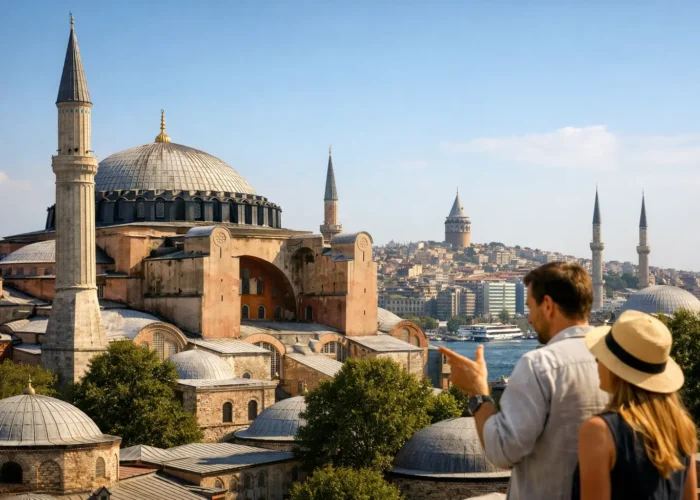
The most revealing view of Byzantine Constantinople is not always the most obvious one. It may be the gold light high inside Hagia Sophia, a weathered marble fragment beside the Hippodrome, or a quiet church hidden behind Istanbul’s busy streets. This Istanbul Byzantine heritage guide is designed for travelers who want to understand the former imperial capital with context, comfort, and a thoughtfully paced private itinerary.
For nearly 1,100 years, Constantinople was the heart of the Byzantine Empire. Its emperors ruled from palaces overlooking the Sea of Marmara, its patriarchs shaped Orthodox Christianity, and its artists created interiors that influenced sacred architecture far beyond the city walls. Much has changed since the Ottoman conquest of 1453, yet Byzantine Istanbul remains remarkably present for visitors who know where to look.
Why Byzantine Istanbul Deserves a Private Guide
Byzantine sites in Istanbul are rarely arranged like a single archaeological park. A world-famous monument may sit beside an active mosque, while a small former church can be reached only by navigating residential streets, changing visiting policies, or restoration schedules. The experience is far more rewarding when the places are connected as chapters in one story rather than treated as isolated stops.
A private guide can place each monument in its original setting: the ceremonial route of emperors, the harbor districts that brought goods from across the Mediterranean, and the religious landscape that gave Constantinople its spiritual authority. This perspective also allows for a flexible day. Travelers interested in architecture may spend longer beneath Hagia Sophia’s vast dome; art lovers may prioritize mosaics; families may prefer a balanced route with underground spaces, gardens, and well-timed breaks.
Istanbul Byzantine Heritage Guide: Essential Sites
Hagia Sophia
No visit begins anywhere else. Completed in 537 under Emperor Justinian I, Hagia Sophia was an extraordinary feat of engineering and a powerful statement of imperial faith. Its central dome seems to float above the interior, supported by a sophisticated system of pendentives, arches, and half domes. Even after centuries of earthquakes, repairs, conversion, and restoration, the building retains an almost startling sense of scale.
Hagia Sophia’s layered identity is central to its meaning. It served as the cathedral of Constantinople, became an imperial mosque after 1453, functioned as a museum for much of the modern era, and now operates as a mosque again. Visitor access, routes, and rules can change, particularly around prayer times and restoration work. Modest dress and an itinerary that allows for flexibility are essential. A knowledgeable guide helps distinguish original Byzantine features from later Ottoman additions while explaining why both belong to the building’s living history.
Hippodrome and Sultanahmet Square
Just outside Hagia Sophia, the former Hippodrome was Constantinople’s great arena for chariot racing, public ceremony, and political theater. The track itself has disappeared beneath modern Sultanahmet Square, but several monuments remain on its ancient spine. The Egyptian Obelisk, brought from Luxor in the fourth century, still stands on its carved imperial base. Nearby are the Serpent Column and the Walled Obelisk.
This stop is brief but essential. It reveals that Byzantine public life was never confined to churches and palaces. Crowds here could celebrate victories, demand action from an emperor, or turn sporting rivalries into major political unrest. Standing in the square with expert interpretation makes the invisible city easier to imagine.
Basilica Cistern
Below the streets near Hagia Sophia lies one of Istanbul’s most atmospheric survivals. The Basilica Cistern was built in the sixth century to store water for the Great Palace and surrounding districts. Its forest of columns, reflected in shallow water, creates an evocative contrast to the sunlight and crowds above ground.
The two Medusa-head column bases are its best-known details, though the real fascination is logistical. Constantinople depended on an immense water system of aqueducts, channels, and reservoirs. The cistern demonstrates the practical sophistication behind imperial grandeur. Because lighting programs and visitor flow can vary, an early or late visit often offers a more composed experience.
Hagia Irene
Within the outer grounds of Topkapi Palace, Hagia Irene offers a quieter encounter with Byzantine sacred architecture. The present structure was rebuilt after the Nika revolt and is among the city’s oldest surviving churches. Unlike Hagia Sophia, it was not converted into a mosque after the conquest, preserving a notably restrained interior.
Its large apse bears a simple cross rather than a figural mosaic, a detail often associated with the period of Iconoclasm, when religious images became a source of intense debate in the Byzantine world. Access can be more limited than at the city’s headline attractions, so it works best as part of a carefully planned private day rather than an assumed walk-in stop.
Chora Church, or Kariye
For many travelers, Chora is the artistic high point of Byzantine Istanbul. Tucked into the Edirnekapi neighborhood near the old land walls, this former monastery church is celebrated for its late Byzantine mosaics and frescoes. Its scenes from the lives of the Virgin Mary and Christ are remarkably expressive, intimate, and detailed.
The most famous image, the Anastasis, depicts Christ breaking the gates of Hades and raising Adam and Eve from their tombs. It is one of the great visual statements of Byzantine theology. Chora’s status and access arrangements have changed in recent years, and conservation activity may affect what can be seen. It is worth planning around current conditions rather than promising a fixed experience months in advance.
The Land Walls of Theodosius II
To understand why Constantinople endured for so long, visit its land walls. Built in the early fifth century and strengthened over time, this formidable defensive system stretched from the Sea of Marmara to the Golden Horn. Moats, towers, and multiple lines of fortification helped the city withstand sieges for centuries.
The walls are not a polished monument in the manner of Hagia Sophia, which is precisely part of their appeal. A guided drive or walk along selected sections can illuminate the geography of the 1453 conquest and the sheer scale of the city Byzantium protected. The terrain is uneven in places, so this stop should be tailored to mobility needs and weather.
Building a Well-Paced Byzantine Day
A strong first-time route usually combines Hagia Sophia, the Hippodrome, Basilica Cistern, and one additional site such as Hagia Irene or Chora. This approach gives travelers the essential imperial center without turning the day into a race between ticket lines and traffic. Chora and the land walls are best treated as a separate extension or a second day, especially for guests who want time to appreciate the art rather than simply photograph it.
Timing matters. The historic peninsula is busiest in late morning, and mosque schedules affect access at active religious sites. Private transportation is especially valuable when connecting Sultanahmet with Chora, the walls, or other neighborhoods beyond the central core. It reduces unnecessary transitions and leaves more room for interpretation, a relaxed lunch, or a pause at a neighborhood café.
For travelers arriving by cruise ship, a bespoke shore excursion should be planned conservatively, with clear return timing and a site sequence that accounts for port traffic. For couples, families, and multigenerational groups, the best pace depends on energy levels, interests, and whether the day also includes Ottoman landmarks such as Topkapi Palace or the Blue Mosque.
What to Look for Beyond the Famous Monuments
The richest Byzantine experiences often come from details. Look for reused marble columns, known as spolia, in churches and cisterns. Notice how Ottoman mosques, bazaars, and residences occupy the same ridges and waterfronts once shaped by Byzantine institutions. In Istanbul, history is not arranged in neat eras. It is continuously built over, adapted, and reinterpreted.
A specialist guide can also help travelers read the city’s visual language: Greek inscriptions, monograms on capitals, brickwork patterns, and the careful placement of churches near roads, harbors, and defensive walls. These elements turn a sightseeing day into a genuine encounter with Constantinople’s former world.
Bosphorus Gate Travel can curate a private Byzantine-focused experience around your preferred pace, including expert guiding, premium transportation, and the flexibility needed for changing site conditions. Allow time for the unexpected: a mosaic seen from a new angle, a quiet wall tower, or the realization that beneath modern Istanbul, an imperial city is still very much present.