
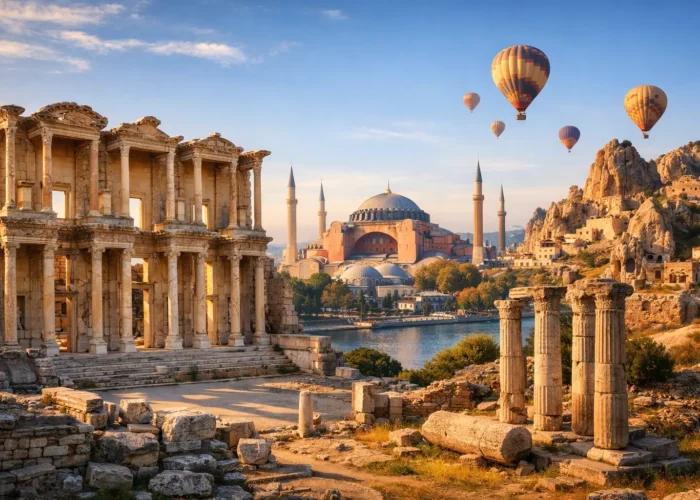
A Roman street still marked by carriage wheels. A Byzantine church carved inside volcanic stone. An Ottoman palace overlooking the Bosphorus. The best Turkey destinations for history lovers do not present the past as a single era or a museum exhibit. They place you directly among the civilizations that shaped Europe, Asia, and the Mediterranean.
Turkey rewards travelers who want more than a checklist of ruins. Its historical sites span ancient Anatolian kingdoms, Greek and Roman cities, early Christianity, the Byzantine Empire, Seljuk architecture, and the Ottoman world. The key is choosing an itinerary with enough time, expert context, and comfortable logistics to appreciate how these chapters connect.
Why Turkey Is Exceptional for Historical Travel
Few countries offer this concentration of major historical periods in one journey. In Istanbul, Roman imperial foundations sit below Byzantine churches and Ottoman mosques. On the Aegean coast, Ephesus preserves one of the Mediterranean’s most impressive Roman urban landscapes. In central Anatolia, Cappadocia’s rock-cut churches tell the story of early Christian communities, while southeastern sites such as Göbekli Tepe push the timeline of human ritual back thousands of years.
The trade-off is distance. Turkey is a large country, and attempting to cover every celebrated site by road can turn an enriching trip into a rushed one. A well-designed private itinerary typically combines Istanbul with two or three regions, using domestic flights and private transportation to protect time for the places that matter most.
Best Turkey Destinations for History Lovers
Istanbul: Roman, Byzantine, and Ottoman Legacies
Istanbul is the essential starting point because its history is layered rather than separated. Originally Byzantium, then Constantinople, and later the capital of the Ottoman Empire, the city allows visitors to trace more than 1,500 years of imperial ambition within a remarkably compact historic center.
Hagia Sophia remains the defining experience. Built as a Byzantine cathedral in the sixth century, converted into an Ottoman mosque after 1453, and still an active sacred space, it reflects the city’s changing identity more powerfully than any textbook can. Nearby, the Basilica Cistern reveals the engineering beneath ancient Constantinople, while the Hippodrome recalls the civic spectacle of the Roman world.
Topkapı Palace brings the Ottoman period into focus through its courtyards, imperial collections, and views over the Bosphorus. For travelers interested in art, diplomacy, and court life, it deserves unhurried time. A private guide is particularly valuable in Istanbul, where the significance of one monument often depends on understanding the building next to it.
Ephesus and the Aegean: Rome at Its Most Vivid
Ephesus is among the most compelling ancient cities in the eastern Mediterranean. Its marble avenues, monumental theater, public baths, terrace houses, and Library of Celsus offer an unusually tangible sense of Roman urban life. This was not a remote outpost. It was a wealthy port city, a commercial center, and an important place in the early Christian world.
The Terrace Houses are especially rewarding for travelers who want to move beyond grand ruins. Their mosaics, frescoes, heating systems, and carefully planned rooms reveal how the city’s affluent residents lived. Access is controlled and the site requires an additional entry arrangement, making advance planning worthwhile.
The surrounding region deepens the visit. The Basilica of St. John in Selçuk is associated with the apostle John, while the House of the Virgin Mary is an important pilgrimage site for many Christian travelers. Ephesus pairs naturally with a stay in Izmir or a private Aegean itinerary, particularly for guests arriving by cruise ship who want a more considered experience than a standard shore excursion permits.
Cappadocia: Early Christianity Carved in Stone
Cappadocia is often recognized for its fairy chimneys and hot-air balloons, but its historical depth is equally remarkable. For centuries, communities adapted soft volcanic rock into homes, monasteries, chapels, and underground refuges. The region’s landscape was not simply dramatic scenery. It was an environment shaped for survival, worship, and daily life.
The Göreme Open-Air Museum is the best introduction to Cappadocia’s monastic heritage. Its rock-cut churches contain frescoes that illuminate Byzantine religious art and the region’s importance to early Christian communities. The finest interiors may have limited access or separate admission, so an expertly timed visit can make a meaningful difference.
Underground cities such as Kaymaklı or Derinkuyu add another dimension. Their tunnels, ventilation shafts, kitchens, storerooms, and places of worship demonstrate extraordinary planning beneath the surface. Not every traveler will enjoy their narrow passages, especially those with mobility limitations or claustrophobia. In that case, a tailored itinerary can emphasize accessible valleys, monasteries, and panoramic viewpoints without sacrificing historical substance.
Troy and Gallipoli: Myth, Memory, and Modern History
The northwestern Troad offers a different kind of historical journey, one that moves from epic literature to the First World War. Troy is best approached with realistic expectations. The site is archaeologically important precisely because it reveals multiple settlements built over thousands of years, but it does not resemble a fully reconstructed Roman city. Its power lies in the layers of excavation and the enduring questions connecting archaeology with Homer’s Iliad.
Gallipoli, across the Dardanelles, is more immediate and emotionally resonant. Cemeteries, memorials, and former battlefield positions commemorate the 1915 campaign and the soldiers from Turkey, Australia, New Zealand, Britain, France, and beyond. A thoughtful guide helps visitors understand both the military history and the personal stories that make this peninsula so significant.
Combining Troy and Gallipoli works well for travelers with a strong interest in classical literature, archaeology, or twentieth-century history. It is also a rewarding addition between Istanbul and the Aegean, although it should not be squeezed into a single rushed day if reflection is part of the purpose.
Pamukkale and Hierapolis: A Sacred Roman Spa City
Pamukkale’s white travertine terraces are famous, yet the ancient city above them is the historical reason to stay longer. Hierapolis developed around its thermal springs and became a Roman spa destination, with an extensive necropolis, theater, baths, and monumental gates still visible across the hillside.
The theater is one of the site’s highlights, carefully restored with detailed reliefs and broad views across the valley. The ancient pool, where fragments of classical columns lie beneath mineral-rich water, offers a rare chance to experience the same thermal landscape that attracted visitors nearly two millennia ago.
Hierapolis is often paired with Ephesus, but the route is best planned with an overnight stay rather than a long round-trip drive. This creates time to see the ruins when day visitors have departed and to enjoy the region at a more relaxed pace.
Şanlıurfa and Göbekli Tepe: The Earliest Chapters
For travelers drawn to archaeology at its most transformative, southeastern Turkey offers one of the world’s great historical revelations. Göbekli Tepe, near Şanlıurfa, contains monumental stone enclosures dating to the Neolithic period, thousands of years before Stonehenge or the pyramids. Its carved pillars and animal imagery have reshaped scholarly conversations about ritual, settlement, and the beginnings of organized society.
The experience is strongest when paired with Şanlıurfa’s Archaeology Museum, where the broader context of prehistoric Anatolia becomes clearer. This is a destination for travelers willing to add a domestic flight and devote real attention to the region. It may not fit a first, shorter trip to Turkey, but for serious history enthusiasts, it can become the journey’s most unforgettable stop.
How to Build a History-Focused Turkey Itinerary
For a first visit, seven to ten days can support an elegant route through Istanbul, Cappadocia, and Ephesus. This combination balances imperial capitals, early Christian heritage, and Roman antiquity while keeping transfers manageable. Add Pamukkale for a slower Aegean journey, or choose Troy and Gallipoli when military history and classical mythology are central interests.
A 12- to 14-day itinerary provides more flexibility for destinations such as Antalya’s Roman sites, including Perge and Aspendos, or for the deeper archaeological experience of Şanlıurfa and Göbekli Tepe. Season matters as well. Spring and fall generally offer the most comfortable conditions for walking extensive outdoor sites, while summer calls for earlier starts, shaded pauses, and a vehicle waiting close by.
Historical travel is richer when logistics do not compete with discovery. Private guides can tailor the pace, explain details that signage cannot capture, arrange entry efficiently, and shape the day around personal interests, whether that means Byzantine mosaics, biblical history, Roman engineering, or Ottoman design. Bosphorus Gate Travel creates these expertly curated experiences with private transportation, thoughtful accommodations, and the flexibility to linger where the story becomes most compelling.
Choose the places that speak to your own definition of history, then give them the time they deserve. Turkey’s greatest sites are not simply places to photograph. They are places to stand still, listen closely, and see how remarkably near the past can feel.