
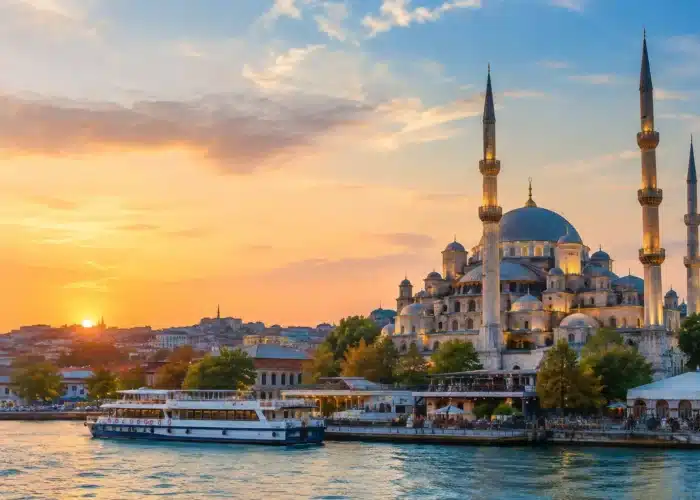
A search for “best Ottoman landmarks Istanbul” can produce a long list of mosques, palaces, and markets. The more rewarding question is how to experience them in a way that reveals the empire behind the architecture. Istanbul was the Ottoman capital for nearly five centuries, and its landmarks are not isolated sights. They form a living map of imperial ceremony, faith, trade, diplomacy, and daily life.
For travelers who value depth as much as convenience, the ideal day balances the essential monuments with quieter details: a courtyard fountain, a calligraphed dome, a Bosphorus-facing palace room, or a guide’s explanation of how the sultans governed an empire across three continents. These are the Ottoman sites that deserve a place in a thoughtfully curated Istanbul itinerary.
The Best Ottoman Landmarks in Istanbul
1. Topkapi Palace
Topkapi Palace is the natural starting point for understanding Ottoman Istanbul. From the late 15th century until the 19th century, it served as the administrative and residential heart of the empire. Its sequence of courtyards creates a deliberate transition from public authority to the sultan’s private world.
Allow time for more than the Treasury. The Imperial Council Chamber, palace kitchens, sacred relics collection, and Harem each reveal a different layer of court life. The Harem is especially valuable with expert interpretation, since it was a complex household and political institution rather than the fantasy often suggested by popular culture. Morning is best, before the palace’s most visited rooms become crowded.
2. Süleymaniye Mosque
Perched above the Golden Horn, Süleymaniye Mosque is one of the great works of Mimar Sinan, the Ottoman Empire’s most influential architect. Commissioned by Sultan Süleyman the Magnificent, it combines monumental scale with remarkable restraint. Its broad central dome, elegant proportions, and peaceful gardens make it feel very different from the busier mosques of Sultanahmet.
The surrounding complex once included schools, a hospital, kitchens, baths, and commercial spaces. That setting matters: an imperial mosque was designed as a civic center, not simply a place of worship. Visit outside prayer times, dress respectfully, and take a moment at the terrace behind the complex for one of Istanbul’s most memorable views.
3. The Blue Mosque
Officially the Sultan Ahmed Mosque, the Blue Mosque was built in the early 17th century as an imperial statement across from Hagia Sophia. Its six minarets and cascading domes define Istanbul’s historic skyline, while the interior is known for thousands of blue and turquoise İznik tiles.
This remains an active mosque, so its opening hours can shift around daily prayers and Friday services. That can be a trade-off for independent visitors with a tight schedule. A well-planned private tour can place the mosque at the right point in the day and pair it with the Hippodrome and surrounding Old City monuments for a clearer sense of the imperial district.
4. Rüstem Pasha Mosque
Rüstem Pasha Mosque is smaller than Süleymaniye or the Blue Mosque, but its artistic impact is extraordinary. Tucked above the shops near the Spice Bazaar, it is celebrated for its exceptional 16th-century İznik tiles. Look closely at the rich tulips, carnations, hyacinths, geometric borders, and vivid coral-red details.
The intimate scale is part of its appeal. This is where travelers can appreciate Ottoman decorative arts without the pressure of a major palace queue or a vast prayer hall. Its entrance can be easy to miss, making it a particularly rewarding stop when accompanied by a knowledgeable local guide.
5. The Grand Bazaar
The Grand Bazaar is far more than a shopping stop. Established under Mehmed II and expanded over centuries, it was a commercial engine for the Ottoman capital. Its covered lanes once organized merchants by craft and trade, bringing textiles, jewelry, carpets, spices, and luxury goods into the center of imperial life.
Today, the experience depends on how you approach it. Travelers seeking fixed-price modern retail may find it overwhelming, while those interested in craftsmanship, merchant culture, and the architecture of trade will find it fascinating. A focused visit is usually more enjoyable than wandering without purpose. An expert can help distinguish long-standing ateliers from generic souvenir stalls and make time for the bazaar’s historic hans, or caravanserais.
6. The Spice Bazaar
The Spice Bazaar, also called the Egyptian Bazaar, was built in the 17th century to support the nearby New Mosque complex. Its name reflects the goods that reached Istanbul through Egypt and the wider eastern Mediterranean trade network.
The market is compact, colorful, and ideal for a sensory pause between historic sites. Dried fruits, tea, Turkish delight, saffron, and spice blends are part of the experience, but the architecture should not be overlooked. The vaulted corridors and orderly design reflect the practical sophistication of Ottoman commercial planning. Go earlier in the day for a more comfortable visit.
7. Dolmabahçe Palace
Dolmabahçe Palace marks a dramatic change in Ottoman taste and politics. Completed in the mid-19th century on the Bosphorus, it replaced Topkapi as the empire’s principal administrative residence. Its lavish European-inspired interiors, grand ceremonial staircase, and monumental crystal chandelier reflect an empire engaging with the diplomatic and cultural currents of its era.
Some visitors prefer Topkapi’s layered history and intimate courtyards, while others are captivated by Dolmabahçe’s theatrical scale. Both belong on a complete Ottoman itinerary because they tell different chapters of the same story. Timed entry and efficient transportation are particularly helpful here, as the palace visit is best combined with a Bosphorus experience rather than treated as an isolated stop.
8. Beylerbeyi Palace
On the Asian shore of the Bosphorus, Beylerbeyi Palace offers a more relaxed and personal counterpoint to Dolmabahçe. Built as a summer residence and state guesthouse, it welcomed foreign rulers and dignitaries during the 19th century. Its interiors blend Ottoman sensibilities with European decorative influences, while the water-facing setting provides its own sense of occasion.
Reaching Beylerbeyi requires crossing the Bosphorus, which is precisely why it works so well within a private itinerary. It can be paired with a scenic drive, a waterfront lunch, or a cruise that places the palace in the context of Istanbul’s extraordinary shoreline.
9. Ortaköy Mosque
The Ortaköy Mosque, formally known as Büyük Mecidiye Mosque, is one of Istanbul’s most photogenic Ottoman landmarks. Built in the 1850s beside the Bosphorus, it is smaller than the great imperial mosques but exceptionally well placed. The Bosphorus Bridge rising behind it creates a striking contrast between Ottoman elegance and modern Istanbul.
Its ornate, light-filled interior reflects the late Ottoman Baroque style. Because it is an active mosque and a popular waterfront stop, timing matters. A visit in the late afternoon can be especially beautiful, though the neighborhood is often lively. This is a place to savor rather than rush.
10. Yıldız Palace
Yıldız Palace offers a less predictable perspective on the late Ottoman court. Sultan Abdülhamid II made the wooded complex his primary residence in the late 19th century, favoring its relative privacy over the exposed grandeur of Dolmabahçe. The pavilions, gardens, and collections offer a useful contrast to Istanbul’s better-known palaces.
It is an excellent choice for repeat visitors or travelers who want their itinerary to move beyond headline attractions. Availability and visiting arrangements can vary, so it is best included with current local guidance rather than assumed to fit every schedule.
Planning an Ottoman Istanbul Day with Purpose
The most satisfying route is rarely the one that checks off the most sites. The Old City works beautifully for Topkapi Palace, the Blue Mosque, Süleymaniye, Rüstem Pasha Mosque, and the bazaars, but it involves uneven streets, prayer-time considerations, and crowds. Dolmabahçe, Ortaköy, and Beylerbeyi belong more naturally to a separate Bosphorus-focused day.
Private transportation becomes especially valuable when connecting landmarks on different shores or when traveling with family members who prefer a measured pace. A private guide also adds meaning where signage alone cannot: why a sultan chose a particular palace, how Ottoman charitable foundations funded public life, and what details in a mosque reveal the status of its patron.
Bosphorus Gate Travel can arrange a private, expertly paced Istanbul experience around your interests, whether your priority is imperial architecture, sacred art, family-friendly storytelling, or a refined day that combines palaces with the Bosphorus. Leave room in the schedule for a quiet courtyard and an unplanned view. In Istanbul, those pauses often become the moments you remember most.