
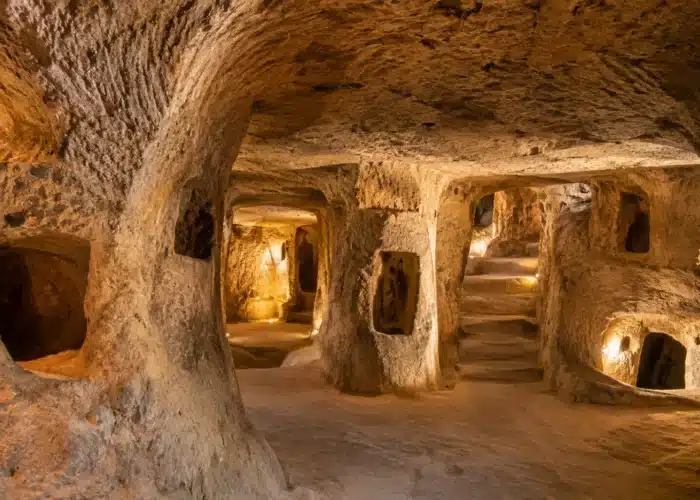
A narrow passage descends beneath an ordinary Cappadocian hillside, then opens into rooms built for an entire hidden community. The Cappadocia underground cities are not simply caves or storage chambers. They are remarkably organized subterranean settlements, shaped over centuries to protect families, livestock, food stores, and religious life during periods of danger.
For travelers who want more than a quick photo stop between balloon flights and valley views, these cities offer one of Turkey’s most compelling historical experiences. Their low ceilings, hand-cut ventilation shafts, and stone doors reveal a practical sophistication that is difficult to grasp without standing inside them. A well-planned visit, ideally with a knowledgeable private guide, brings their purpose and human scale into focus.
Why Cappadocia’s Underground Cities Matter
Cappadocia’s volcanic landscape is famous for its fairy chimneys and soft tuff rock, but that same rock made underground construction possible. Local communities began carving shelters and chambers into the region’s geological formations in ancient times. Over generations, some of these spaces expanded into multi-level cities that could accommodate thousands of people for extended periods.
The settlements were used by different populations across the centuries, including early Christian communities seeking refuge during invasions and religious persecution. Their design was defensive but not crude. Residents created living quarters, kitchens, stables, wineries, wells, chapels, storage areas, and ventilation networks far below ground.
What makes the experience especially moving is the evidence of everyday life. Blackened kitchen ceilings point to long-ago cooking fires. Deep troughs recall animals kept safely indoors. Circular stone doors, rolled into place from within, once sealed passages against intruders. These details turn a visit from a history lesson into a vivid encounter with human ingenuity.
Derinkuyu and Kaymakli: The Essential Visits
The two most visited sites are Derinkuyu and Kaymakli, both located within easy reach of Cappadocia’s principal hotel areas. They share a common purpose, but each offers a distinctly different experience.
Derinkuyu: Depth and Drama
Derinkuyu is generally regarded as the deepest of the accessible underground cities. Its explored levels descend dramatically, with routes leading visitors through narrow corridors into larger communal spaces. Archaeologists believe the city may have extended roughly 200 feet underground, although only portions are open to the public.
This is the stronger choice for travelers fascinated by scale and engineering. Derinkuyu has a powerful sense of descent: as you move farther below the surface, it becomes easier to imagine the pressure of living in a protected world with limited light and controlled access. Its missionary school, large ventilation shaft, and defensive stone doors are particularly memorable.
The trade-off is that Derinkuyu can feel more demanding. Some passageways are low, steep, or confined, and the drive from central Cappadocia is typically longer than the journey to Kaymakli. It is best approached unhurriedly, with time to pause and understand what you are seeing.
Kaymakli: A Clearer Sense of Daily Life
Kaymakli is often easier to navigate and can feel more intimate, even though its network is extensive. Its open route reveals a compelling mix of domestic and communal areas, including kitchens, storage rooms, stables, and spaces thought to have supported wine production.
For families, first-time visitors, and travelers who are curious about the cities but uncertain about tight spaces, Kaymakli may be the more comfortable introduction. The pathways can still be narrow, and visitors should expect uneven stone floors, but the site often gives a clearer view of how separate rooms functioned together.
There is no universal answer to which city is “better.” Derinkuyu emphasizes depth and defensive complexity; Kaymakli offers a more immediate impression of household life below ground. An expertly curated Cappadocia itinerary can select the right site based on your interests, mobility, hotel location, and the pace you prefer.
What It Feels Like Underground
The temperature underground is generally cool and stable, a welcome contrast to Cappadocia’s summer heat but a reason to bring a light layer in cooler months. Lighting is installed along visitor routes, yet the atmosphere remains naturally dim. The floors are stone, the turns are frequent, and certain corridors require visitors to bend slightly or walk single file.
Most guests find the visit fascinating rather than frightening. Still, it is wise to be candid about comfort levels. Travelers with significant claustrophobia, balance concerns, severe knee issues, or difficulty walking on uneven surfaces may prefer a shorter route or may choose to focus on Cappadocia’s open-air highlights instead.
A private guide adds genuine value here. The cities do not always announce their stories clearly through signage alone. Knowing why a ventilation shaft mattered, how a door was secured, or where a family may have prepared food gives meaning to rooms that might otherwise appear similar.
Planning a Comfortable Visit
Underground-city visits are usually most enjoyable when scheduled as part of a balanced day. Pairing one with an open-air destination such as Ihlara Valley, a panoramic viewpoint, or a relaxed local lunch creates a satisfying rhythm between enclosed history and Cappadocia’s expansive scenery.
Morning visits are often a smart choice, especially during high season, when popular sites become busier later in the day. Comfortable walking shoes with good grip are essential. Avoid large backpacks, as narrow passages can make them awkward, and keep valuables secure rather than carrying loose items.
Photography is permitted in many areas, but low light makes it challenging. Rather than relying on flash, which can disturb the mood and other visitors, take a few considered images and allow yourself time to absorb the setting. This is one of those places where the most lasting impression may not be on a camera roll.
Practical Considerations Before You Go
Entrance areas and visitor routes can change with conservation work, crowd management, or weather-related conditions. A professional local guide can help ensure the day’s plan remains efficient, particularly if you are traveling with children, older family members, or a private group with different interests.
Allow roughly one to two hours for the visit itself, depending on the site, crowds, and how deeply you wish to explore. The experience is not physically strenuous in the conventional sense, but it does require attention, patience, and a reasonable level of mobility. Visitors should also avoid rushing immediately after a large meal if enclosed spaces make them uncomfortable.
Beyond the Main Sites
Derinkuyu and Kaymakli are the best-known choices, but they are not the only underground settlements in the region. Özkonak and Mazi can be appealing alternatives for travelers seeking a quieter experience or a different route through Cappadocia’s subterranean heritage.
The right choice depends on the broader itinerary. If your day includes the southern valleys, Derinkuyu may fit naturally. If you are staying near Göreme and want to limit driving time, Kaymakli can be especially convenient. Those prioritizing a more exclusive pace may appreciate discussing lesser-visited options with a local specialist.
It is also worth remembering that underground life was only one part of Cappadocia’s story. The region’s rock-cut churches, frescoed monasteries, caravan routes, vineyards, and villages offer essential context. Combining these experiences reveals a landscape where people continuously adapted the land above and below ground.
A Private Visit Makes the Difference
Cappadocia rewards thoughtful pacing. A crowded, rushed stop can make an underground city feel like a maze of stone corridors. A private experience transforms it into a carefully interpreted journey through a hidden civilization, with transportation arranged around your schedule and time to ask the questions that matter to you.
Bosphorus Gate Travel can incorporate an underground city into a personalized Cappadocia program, balancing it with the region’s signature landscapes, boutique accommodations, and cultural experiences. For couples, families, and travelers seeking meaningful access without logistical friction, that level of planning allows the history to remain the focus.
When you emerge back into Cappadocia’s bright volcanic landscape, take a moment before moving on. The contrast between the open valleys above and the carefully guarded world below is precisely what makes this region unforgettable.
[…] touring day is affected. Your private guide can still arrange an exceptional day among the valleys, underground cities, artisan workshops, and historic villages while the balloon operator monitors the next […]
[…] the Göreme Open-Air Museum, Pasabag Valley, Avanos pottery traditions, Kaymaklı or Derinkuyu Underground City, and a sunset walk in Red or Rose Valley. The right base makes those days feel easy rather than […]